
In this article
- The short answer: the best QuickBooks alternative for each situation
- Why so many businesses are leaving QuickBooks right now
- 1. The price went up again
- 2. You pay for people, not for work
- 3. QuickBooks Desktop is closed to new US buyers
- 4. The bookkeeping is still on you
- Before you switch: is QuickBooks really the problem?
- QuickBooks alternatives compared at a glance
- How we picked and ranked these alternatives
- The 10 best QuickBooks alternatives for 2027
- 1. Tyms: best for small businesses that want the bookkeeping done for them
- 2. Xero: best for teams that keep paying for extra users
- 3. Zoho Books: best for the lowest bill
- 4. FreshBooks: best for freelancers who mostly send invoices
- 5. Wave: best free option for micro-businesses
- 6. Odoo: best all-in-one suite on a budget
- 7. Sage Intacct: best for mid-sized and multi-entity companies
- 8. Oracle NetSuite: best when you need a full ERP
- 9. Microsoft Dynamics 365 Business Central: best if you run on Microsoft
- 10. Don't switch yet: QuickBooks with Tyms on top
- What each alternative really costs for your team size
- Will your new accounting software still be around in five years?
- How to switch from QuickBooks without the risk
- For accounting firms: the price rise is multiplied by every client
- AI in QuickBooks vs AI-native accounting: what's the difference?
- Our verdict
- References
- Common questions
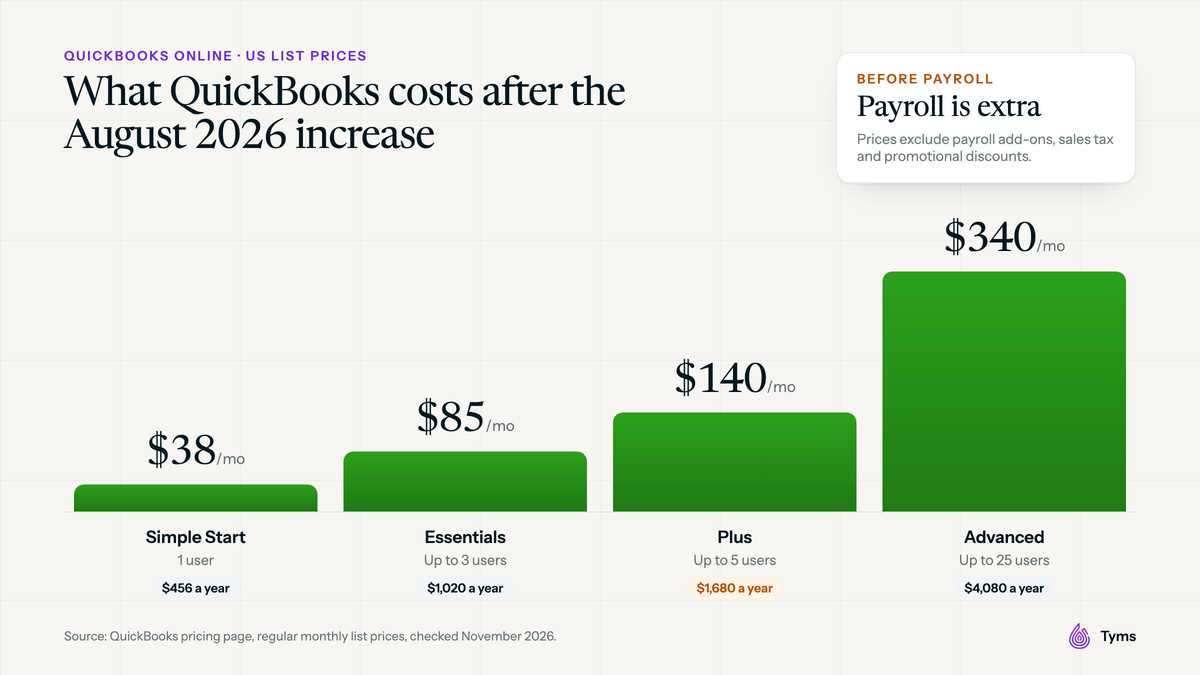
Your QuickBooks renewal email probably said it nicely, but the number is what it is. Since August 1, 2026, QuickBooks Online Plus lists at $140 a month and Advanced at $340 a month in the US, before payroll, add-ons or sales tax[1][2]. For a five-person team on Plus, that's $1,680 a year just to keep the books open.
The price is only part of it. Plenty of owners and accountants are paying more every year and still spending their evenings downloading statements, categorizing transactions and matching payments by hand. Paying more to do the same manual work is what finally makes people search for an alternative.
This guide is for that moment. We compare 10 QuickBooks alternatives, with prices checked on each vendor's own pricing page in November 2026. We group them by why you're leaving, because the right replacement for "it's too expensive" is not the right one for "I've outgrown it". We also cover what the other lists skip: what each option really costs for your team size, how to tell whether a newer tool will still be around in five years, and how to switch without betting your books on it.
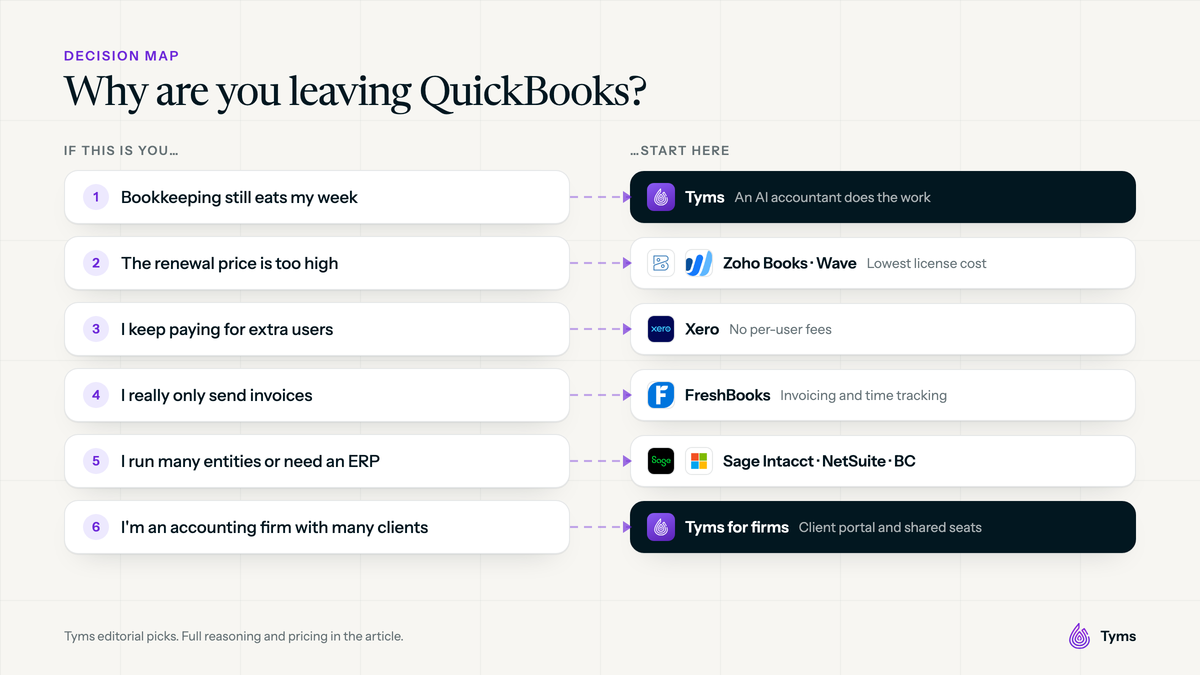
Short on time? If manual bookkeeping is the real problem, start with Tyms. If you only want the lowest bill, look at Zoho Books or Wave. If you keep paying for extra users, look at Xero. If you've outgrown small-business software altogether, look at Sage Intacct, NetSuite or Business Central.
A note on bias: Tyms publishes this guide, and Tyms is on the list. We say so up front. Every competitor price links to its source, and where another product is the better fit, we say that too.
The short answer: the best QuickBooks alternative for each situation
- Best overall for small businesses that want the work done for them: Tyms. An AI accountant, Adam, reconciles, categorizes, invoices and reports, and you approve. $20 per seat a month[3].
- Best for teams that keep paying for extra users: Xero. No per-user license fees, from $27 a month[4].
- Best free option: Zoho Books, which is free while revenue stays at or below $50K a year[5]. Wave's Starter plan is also free[6].
- Best for freelancers who mostly invoice: FreshBooks, from $23 a month[7].
- Best for mid-sized and multi-entity companies: Sage Intacct or Oracle NetSuite (both quote-based).
- Best if you live in Microsoft 365: Dynamics 365 Business Central, from $80 per user a month[8].
- Best all-in-one business suite on a budget: Odoo[9].
- Best if you're not ready to leave yet: keep QuickBooks and connect Tyms on top of it, so the AI does the work while your data stays where it is.
Why so many businesses are leaving QuickBooks right now
QuickBooks is still the default for US small businesses, and for many it works. But four things have pushed a lot of owners and accountants to look around in 2026.
1. The price went up again
From August 1, 2026, Intuit raised QuickBooks Online prices on the Essentials, Plus and Advanced plans at renewal[2]. Intuit's own pricing page now lists Simple Start at $38, Essentials at $85, Plus at $140 and Advanced at $340 a month[1]. Payroll is a separate add-on. Introductory discounts hide this at sign-up, but every business pays the full price at renewal.
2. You pay for people, not for work
QuickBooks plans are capped by users: 1 on Simple Start, 3 on Essentials, 5 on Plus and 25 on Advanced[1]. A sixth person on Plus means moving the whole company to Advanced, a jump from $140 to $340 a month. Growing teams feel this the most.
3. QuickBooks Desktop is closed to new US buyers
Since September 30, 2024, Intuit no longer sells new US subscriptions to QuickBooks Desktop Pro Plus, Premier Plus and Mac Plus[10]. Existing subscribers can renew, but anyone who preferred Desktop now has to move to the cloud anyway. If you have to migrate, it's a natural time to compare.
4. The bookkeeping is still on you
This is the one nobody puts on the invoice. Most accounting software, QuickBooks included, is a very good place to store your books. Someone still has to import statements, fix categories the rules got wrong, match deposits to invoices, chase late payers and work out what the reports mean. Intuit has started adding AI agents to QuickBooks[11], which shows where the market is going. Bolting AI onto a 30-year-old product is still different from a system built around it, as we explain below.
Before you switch: is QuickBooks really the problem?
Switching costs time, so be honest with yourself first. Sometimes the problem is the setup, not the software:
- A messy chart of accounts with hundreds of unused accounts makes any tool feel slow.
- Broken bank feeds are often fixed by reconnecting the bank, not by changing software.
- Too many add-on apps can cost more than the subscription. Check what you actually use.
If none of that applies, and you're paying more every year while still doing the work yourself, then it's time to look. The map below is a good place to start.
QuickBooks alternatives compared at a glance
| Software | Best for | Starting price | Users | Switching effort |
|---|---|---|---|---|
| Tyms | Small businesses and firms that want an AI accountant to do the bookkeeping | $20 per seat a month | Pay per seat | Low: free migration, or run it alongside QuickBooks first |
| Xero | Growing teams that keep paying for extra users | $27 a month (Early) | No per-user fees | Moderate |
| Zoho Books | The lowest bill, especially under $50K revenue | Free; paid from $20 a month | 1 to 15 depending on plan | Low to moderate |
| FreshBooks | Freelancers and service businesses that mostly invoice | $23 a month (Lite) | $11 a month per extra team member | Low |
| Wave | Micro-businesses on a tight budget | Free; Pro $19 a month | Small teams | Low, but fewer features to move into |
| Odoo | Businesses that want accounting, inventory and CRM in one suite | One app free; from $11.20 per user a month | Per user | Moderate to high |
| Sage Intacct | Mid-sized and multi-entity companies | Quote only | Quote only | High |
| Oracle NetSuite | Companies that need a full ERP | Quote only | Quote only | High |
| Dynamics 365 Business Central | Companies standardized on Microsoft | $80 per user a month (Essentials) | Per user | High |
| QuickBooks + Tyms | Teams not ready to leave QuickBooks | $20 per seat a month on top of QuickBooks | Per seat | None: nothing moves |
How we picked and ranked these alternatives
Most "best alternatives" lists don't say how they chose. Here's how we did, so you can weigh our picks against your own priorities.
- Work it takes off your plate (30%). How much routine bookkeeping the software actually does, not just stores: bank feeds, categorization, reconciliation, invoicing and reminders.
- Total cost for a real team (25%). List price at 1, 5 and 10 users, not the cheapest entry plan.
- Switching risk (20%). Data export, API access, migration support, and whether you can test it before you leave QuickBooks.
- Fit for growth (15%). User limits, multi-currency, inventory, approvals and reporting depth.
- Accountant friendliness (10%). Whether your accountant or bookkeeping firm can work in it easily.
Prices are US list prices billed monthly, taken from each vendor's own pricing page in November 2026. We exclude introductory promotions because nobody pays them at renewal. No vendor paid to be included.
The 10 best QuickBooks alternatives for 2027
1. Tyms: best for small businesses that want the bookkeeping done for them
Best for: small businesses, startups and accounting firms that are tired of doing data entry, and want software that does the work and asks them to approve it.
Price: $20 per seat a month, or $200 per seat a year. Each seat includes 1,500 transactions a month, 150 AI credits and 3 bank connections[3]. A Done for you plan adds experts who handle your bookkeeping and tax filing.
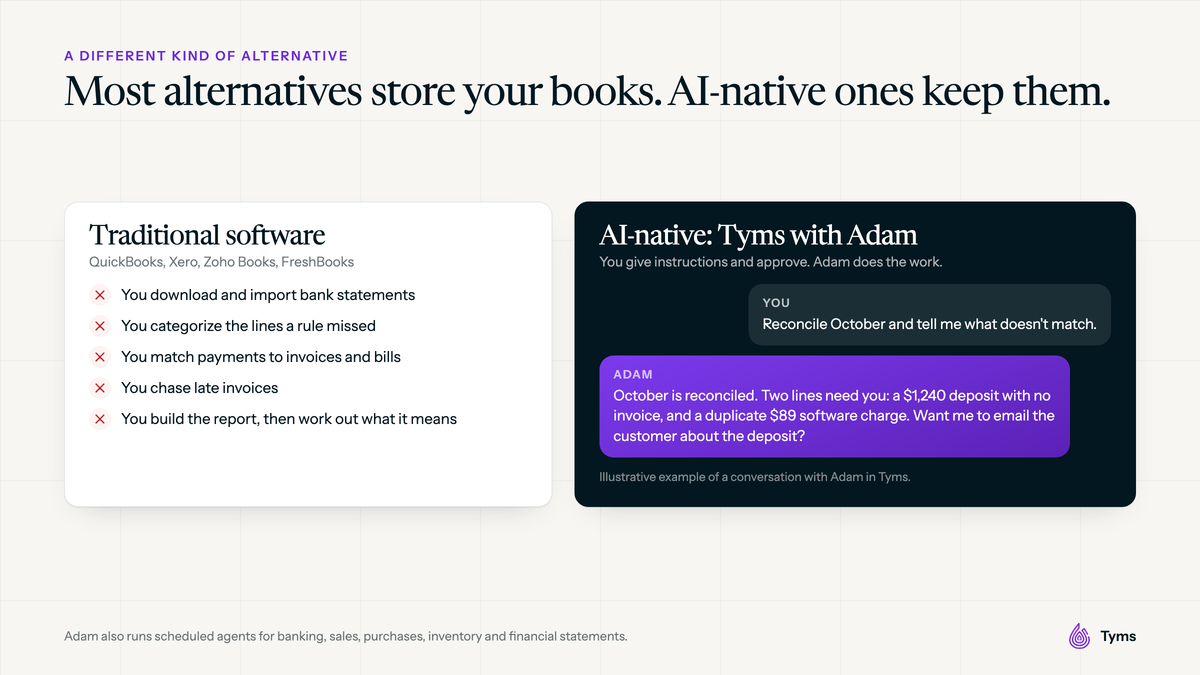
Tyms is accounting software with an AI accountant, Adam, built in. Every other tool on this list asks you to do the bookkeeping inside it. Tyms is built so Adam does the bookkeeping and you review it. You talk to your books in plain English: "reconcile October", "invoice Acme for the March retainer", "why is profit down this quarter?" Adam works from your real ledger, not a guess.
What it does well
- Bank reconciliation that runs itself. US bank feeds connect through Plaid and Stripe Financial Connections, or you can upload statements. Adam categorizes transactions, matches them to invoices and bills, and flags only the lines that need a human.
- Eight scheduled agents. Banking, sales, purchases, inventory, contacts, chart of accounts, fixed assets and financial statements agents can run on a schedule. Your books stay current without anyone opening the app.
- Real double-entry accounting. Chart of accounts, journals, general ledger, fixed assets with depreciation, multi-currency, inventory and manufacturing, and a full set of financial statements.
- US tax-ready. Tyms builds a filled Schedule C from your books and maps your chart of accounts to tax lines.
- Controls for teams. Custom roles, approval workflows, a complete audit log and two-factor sign-in. Tyms is ISO 27001:2022 and SOC 2 Type 2 certified.
- Works where you already are. Chat with Adam over WhatsApp, forward receipts by email, or use Tyms inside Claude, ChatGPT and Perplexity through Tyms MCP.
Where it falls short
- It doesn't run US payroll itself. Keep your payroll provider and record payroll in Tyms.
- It's a newer brand than QuickBooks or Xero, with a smaller app marketplace. An open API, webhooks and Zapier or Make connections cover most gaps.
- For teams of three or more, Xero and Zoho Books have a lower license bill. Tyms makes its case on the hours of work it removes, not the cheapest sticker price.
Skip it if: you run several legal entities with intercompany consolidation and need a full ERP. Look at Sage Intacct or NetSuite instead.
See the full side-by-side on our QuickBooks alternative page.
2. Xero: best for teams that keep paying for extra users
Best for: growing small businesses with several people in the books, and owners whose accountant already uses Xero.
Price: Early $27, Growing $59 and Established $97 a month, with no per-user license fees on any plan[4].
Xero is the closest like-for-like replacement for QuickBooks Online, and it's the most common "best overall" pick on other lists. Its biggest advantage over QuickBooks is pricing by plan, not by user. A ten-person team pays the same as a two-person team.
What it does well: a clean interface, a large app marketplace, solid bank reconciliation, and wide support among accountants.
Where it falls short: the Early plan only allows 20 invoices and 5 bills, so most businesses need Growing. Multi-currency only comes with Established[4]. Payroll in the US relies on a partner. You still do the reconciliation and categorization yourself, with help from rules. We compare it in depth in Tyms vs Xero.
Skip it if: you're a team of one or two and want the lowest bill (Zoho Books or Wave), or you want the work done rather than tracked (Tyms).
3. Zoho Books: best for the lowest bill
Best for: cost-conscious small businesses, and anyone already using Zoho CRM or other Zoho apps.
Price: free for 1 user plus an accountant while revenue stays at or below $50K a year. Paid plans are Standard $20 (3 users), Professional $50 (5 users), Premium $70 (10 users), Elite $150 (10 users) and Ultimate $275 (15 users) a month, billed monthly[5].
Zoho Books gives you more accounting for the money than almost anything else on this list. The free plan is real, not a trial, and the paid plans undercut QuickBooks at every team size.
What it does well: low cost, recurring invoices, a client portal, workflow automation, and tight connections to the rest of the Zoho suite.
Where it falls short: the interface is dense, it works best if you live in Zoho, and like QuickBooks it still leaves the routine bookkeeping to you. See Tyms vs Zoho Books.
Skip it if: you don't use other Zoho apps and want the simplest possible experience.
4. FreshBooks: best for freelancers who mostly send invoices
Best for: freelancers, consultants and agencies whose main job in the books is billing clients and tracking time.
Price: Lite $23 a month for 5 billable clients, Plus $43 for 50 clients and Premium $70 for unlimited clients. Each extra team member costs $11 a month[7].
FreshBooks started as invoicing software, and that's still where it shines. Estimates, invoices, payment reminders, time tracking and expenses are easy for people with no accounting background.
What it does well: the friendliest invoicing on this list and good time tracking.
Where it falls short: client caps on the cheaper plans, team members cost extra, and inventory and reporting are lighter than QuickBooks. Read Tyms vs FreshBooks for a fuller comparison.
Skip it if: you sell products, carry inventory or have more than a handful of people in the books.
5. Wave: best free option for micro-businesses
Best for: sole proprietors and very small businesses that need invoicing and basic books for little or nothing.
Price: Starter is free. Pro is $19 a month and adds automatic bank imports and categorization, unlimited receipt capture and automated late-payment reminders. Payroll is an add-on, and Wave Advisors adds a bookkeeper from $149 a month[6].
What it does well: free invoicing and bookkeeping that cover the basics.
Where it falls short: fewer features than QuickBooks, limited reporting and no inventory. You'll outgrow it as soon as you hire or sell physical products.
Skip it if: you have staff, inventory, or an accountant who needs detailed reports.
6. Odoo: best all-in-one suite on a budget
Best for: businesses that want accounting, inventory, sales, CRM and more in one system.
Price: one app is free with unlimited users. The Standard plan with all apps lists at $11.20 per user a month, with an introductory $8.95 for the first year[9].
What it does well: breadth. You can run most of the company in Odoo, and the per-user price is low.
Where it falls short: it's an ERP, so setup takes real time, and the best results usually need a partner. If you only want to replace QuickBooks' accounting, it's more than you need.
Skip it if: you want to be up and running this week.
7. Sage Intacct: best for mid-sized and multi-entity companies
Best for: finance teams with several entities, departments or locations, and audit-ready reporting needs.
Price: quote only, through Sage or a partner.
Sage Intacct is what companies move to when they've genuinely outgrown QuickBooks: multi-entity consolidation, dimensional reporting and strong controls.
Where it falls short: cost, implementation time, and a learning curve. It's built for a finance team, not a busy owner.
Skip it if: you're a single small business. You'd pay for a lot you won't use.
8. Oracle NetSuite: best when you need a full ERP
Best for: fast-growing companies that need accounting, inventory, order management and more on one platform.
Price: quote only.
What it does well: scales from mid-sized to enterprise, with deep automation and a large partner network.
Where it falls short: implementation takes months and costs real money. It's a business system decision, not a software swap.
Skip it if: your main problem is QuickBooks' price. NetSuite won't be cheaper.
9. Microsoft Dynamics 365 Business Central: best if you run on Microsoft
Best for: companies already standardized on Microsoft 365 and Teams.
Price: Essentials $80 and Premium $110 per user a month, paid yearly, plus Team Members licenses at $8 per user[8].
What it does well: strong financials, inventory and project accounting, with Microsoft's ecosystem around it.
Where it falls short: per-user pricing adds up fast (five users on Essentials is $400 a month), and most companies need a partner to set it up.
Skip it if: you're a small team that just wants simpler, cheaper books.
10. Don't switch yet: QuickBooks with Tyms on top
Best for: businesses and firms that are frustrated with the work, not with QuickBooks itself, or that can't migrate mid-year.
Not every frustration needs a migration. Tyms connects to QuickBooks with a built-in sync and lets you sign in with your QuickBooks account. Adam can then categorize, reconcile and report on your QuickBooks data without you moving anything. It's the lowest-risk way to see what AI-native bookkeeping does for your business. If you later decide to switch fully, your books are already in Tyms. Read more in Supercharge QuickBooks with AI.
What each alternative really costs for your team size
Entry prices are misleading because most businesses don't stay on the entry plan. Here's what the same team pays on each product's list prices.
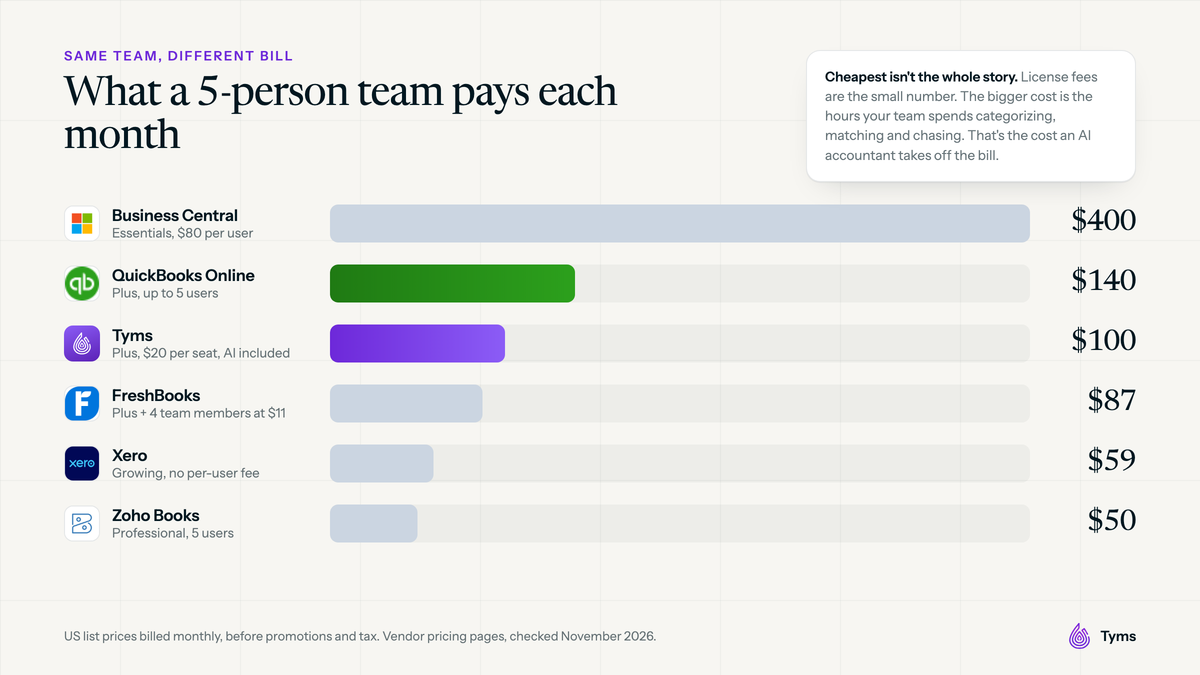
| Software | 1 user | 5 users | 10 users |
|---|---|---|---|
| QuickBooks Online | $38 (Simple Start) | $140 (Plus) | $340 (Advanced) |
| Tyms | $20 | $100 | $200 |
| Xero | $27 to $59 | $59 (Growing) | $59 (Growing) |
| Zoho Books | Free to $20 | $50 (Professional) | $70 (Premium) |
| FreshBooks | $23 (Lite) | $87 (Plus + 4 members) | $142 (Plus + 9 members) |
| Odoo (Standard) | $11.20 | $56 | $112 |
| Business Central | $80 | $400 | $800 |
Two honest takeaways:
- On license price alone, Xero and Zoho Books win once you have three or more people, and Tyms costs less than QuickBooks for any team of up to 16 people.
- License price is the small number. If someone on your team spends 10 hours a month on categorizing and reconciling, that time costs far more than any subscription on this table. The real comparison is subscription plus hours. That's the cost an AI accountant takes down, and it's why Tyms prices per seat instead of competing to be the cheapest. Check Tyms pricing for annual plans.
Will your new accounting software still be around in five years?
This is the question that stops most people from leaving QuickBooks, and it's a fair one. Your books are not something you can afford to lose.
It happens. On December 27, 2024, US bookkeeping provider Bench abruptly shut down, days before tax season, leaving thousands of small-business customers scrambling for their records[12]. Days later, Employer.com agreed to buy Bench and said it would restore the service[13], but its customers learned a hard lesson: what matters isn't whether a vendor can fail. It's whether you can walk away cleanly if it does.
Nobody can promise you a company will never close, including Intuit. What you can check is whether your data is locked in. Ask every vendor these six questions before you sign.
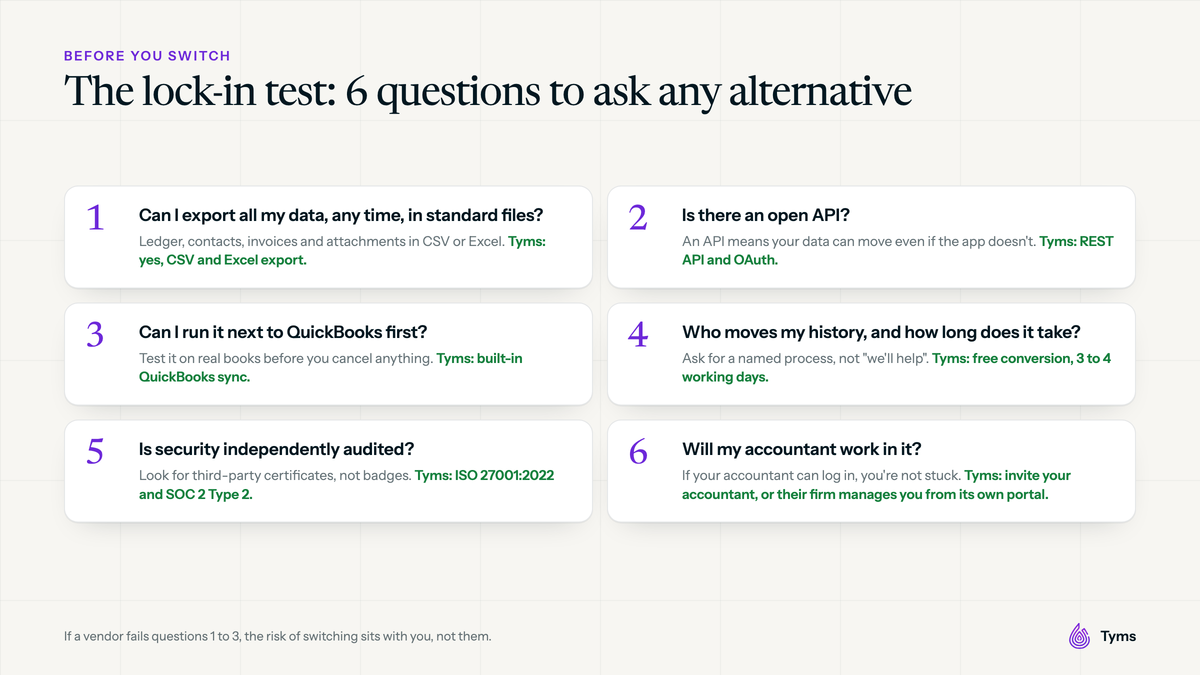
- Can I export all my data, any time, in standard files? Ledgers, contacts, invoices and attachments, in CSV or Excel. With Tyms, you can export your general ledger, reports and records to CSV or Excel whenever you like.
- Is there an open API? An API means your data can move even if the app doesn't. Tyms has a REST API for invoices, bills, journals, contacts, bank transactions and financial statements, plus OAuth for third-party apps.
- Can I run it next to QuickBooks first? Testing on live books is worth more than any demo. Tyms syncs with QuickBooks, so you can.
- Who moves my history, and how long does it take? Ask for a named process, not "we'll help you". Tyms migration is run by MMC Convert, free, in 3 to 4 working days for QuickBooks, Xero, Zoho Books and Sage[14].
- Is security independently audited? Look for third-party certificates. Tyms is ISO 27001:2022 and SOC 2 Type 2 certified.
- Will my accountant work in it? If your accountant or bookkeeping firm can log in, you're never stuck. Tyms lets you invite your accountant, and firms can manage all their clients from their own portal.
If a vendor can answer all six, a shutdown would be an inconvenience, not a disaster. That's a better guarantee than brand size.
How to switch from QuickBooks without the risk
The safest switch is the one where you never stop having working books. Here's the path we recommend, whichever alternative you choose.
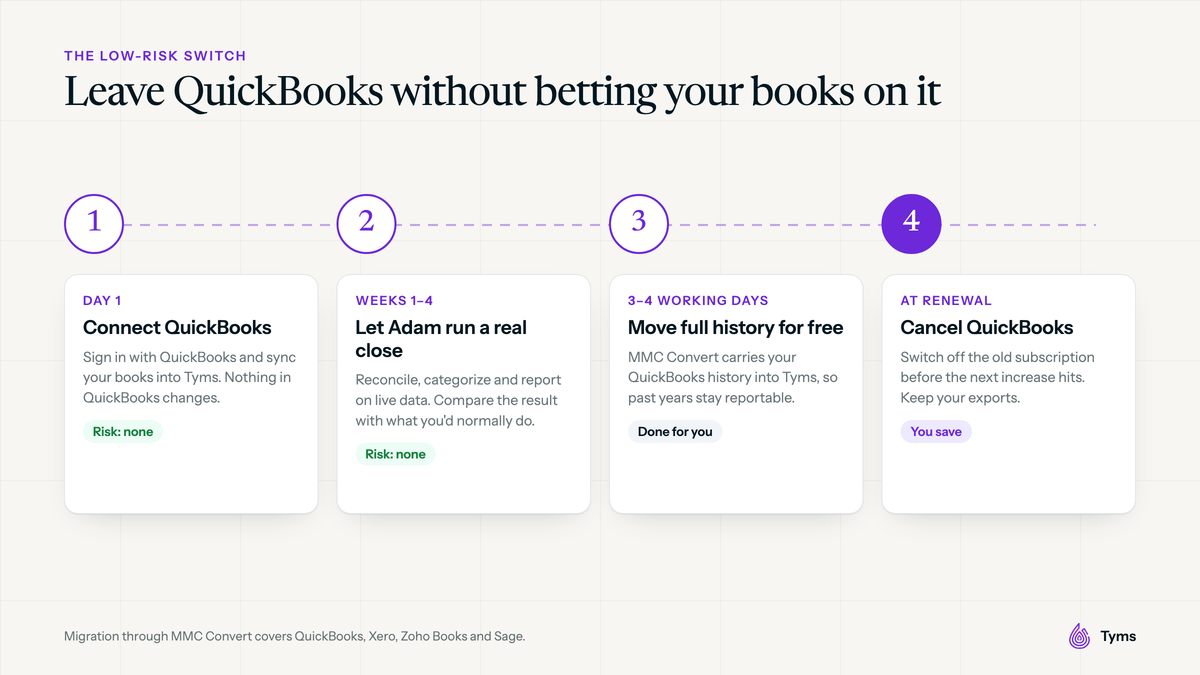
- Connect, don't cancel. Start the new software alongside QuickBooks. With Tyms, sign in with QuickBooks and sync. Nothing in QuickBooks changes.
- Run one real month-end close in both. Reconcile the same month in each and compare the result and the time it took. This is the only test that matters.
- Move your full history. Use the vendor's migration service so past years stay reportable. For Tyms, that's a free conversion through Migrate to Tyms.
- Cancel QuickBooks before your next renewal date. Check the renewal date in your QuickBooks account settings so you don't pay for another term you won't use.
Your pre-switch checklist
- Pick a clean cutover date, ideally a month or quarter end.
- Export a trial balance, balance sheet and profit and loss as of the cutover date.
- Export open invoices (accounts receivable) and unpaid bills (accounts payable).
- Note the last reconciled date and balance for every bank and card account.
- Export your customer, vendor, product and service lists.
- Save attachments and receipts linked to transactions.
- Write down your sales tax settings and any 1099 vendor details.
- Keep read-only access to QuickBooks, or a full export, for at least as long as you must keep records.
For a fuller walk-through, see How to switch from QuickBooks to another accounting software.
For accounting firms: the price rise is multiplied by every client
If you run a bookkeeping or CPA practice, the 2026 increase didn't hit you once. It hit every client on QuickBooks, and your clients are asking you what to do.
Tyms has a practice side built for that conversation:
- One portal for every client. Manage client businesses, assign staff, and see firm-wide and per-client analytics and audit logs.
- Your brand, not ours. A white-label portal on your own subdomain or custom domain, with a public firm profile and lead capture.
- Bill clients from the same place. One-off or subscription invoices to clients, paid through Stripe Connect.
- Buy seats and AI credits in bulk and hand them out to clients.
- Adam does the first pass on every client's bank lines, so your team reviews instead of keying in.
Learn more on Tyms for accountants or read the best AI accounting software for CPA firms.
AI in QuickBooks vs AI-native accounting: what's the difference?
Every major platform now advertises AI. In mid-2025 Intuit launched a set of AI agents for QuickBooks, including agents for accounting, finance and payments[11]. That's a real step forward, and it confirms where accounting software is heading.
The difference is in how the product is built:
- AI added to existing software helps you with tasks inside a workflow designed for a person: suggest a category, draft a reminder, summarize a report. You still drive.
- AI-native software is built around an AI accountant doing the workflow. In Tyms, Adam runs on a schedule, works across banking, sales, purchases, inventory and reporting, follows instructions you give it about how your business works, and brings you only the decisions that need a human.
A useful test: if you went on vacation for two weeks, would your books be more up to date when you came back? With AI-native software, they should be.
Our verdict
There's no single best QuickBooks alternative. There's a best one for the reason you're leaving.
- If the bookkeeping itself is the problem, choose Tyms. It's the only option here built so the software does the work, it costs less than QuickBooks for teams of up to 16 people, and you can try it on your real QuickBooks books before you move anything.
- If you only want a smaller bill, choose Zoho Books or Wave.
- If you keep paying for extra users, choose Xero.
- If you've outgrown small-business software, choose Sage Intacct, NetSuite or Business Central, and budget for implementation.
Whatever you pick, run the lock-in test, switch on your own schedule, and keep your exports.
Ready to see what your books look like when an AI accountant keeps them? Connect QuickBooks to Tyms and let Adam run your next month-end close, or book a demo and we'll walk you through it.
References
- QuickBooks Online plans and pricing Intuit, 2026
- 2026 QuickBooks price increases: what they mean for your renewal SWK Technologies, 2026
- Tyms pricing Tyms, 2026
- Xero US pricing plans Xero, 2026
- Zoho Books pricing (United States) Zoho, 2026
- Wave pricing Wave Financial, 2026
- FreshBooks pricing FreshBooks, 2026
- Dynamics 365 Business Central pricing Microsoft, 2026
- Odoo pricing Odoo, 2026
- Can't buy QuickBooks Desktop as a new US subscriber Intuit, 2024
- Intuit introduces ground-breaking virtual team of AI agents to fuel growth for businesses Intuit, 2025
- Bench Accounting abruptly shuts down ahead of tax season Techcouver, 2024
- Bench Accounting to be acquired by Employer.com following abrupt shutdown GeekWire, 2024
- Migrate to Tyms Tyms, 2026
Common questions
It depends on why you're leaving. If manual bookkeeping is the problem, Tyms is the best fit because its AI accountant, Adam, does the reconciliation, categorization and reporting for you. If you only want a lower bill, Zoho Books or Wave are the cheapest. If you keep paying for extra users, Xero has no per-user fees. Mid-sized and multi-entity companies should look at Sage Intacct, NetSuite or Business Central.
As of November 2026, Intuit lists QuickBooks Online in the US at $38 a month for Simple Start (1 user), $85 for Essentials (up to 3 users), $140 for Plus (up to 5 users) and $340 for Advanced (up to 25 users). Payroll is extra, and introductory discounts only apply for the first months.
Zoho Books is free for one user plus an accountant while your revenue stays at or below $50K a year, and Wave's Starter plan is free. For a five-person team, Zoho Books Professional at $50 a month and Xero Growing at $59 a month are among the lowest list prices.
Yes. Tyms is AI-native accounting software. Its AI accountant, Adam, categorizes and reconciles bank transactions, creates invoices and bills, runs scheduled agents and generates financial statements, and you approve the work. If you want people to do it, the Tyms Done for you plan adds experts who handle bookkeeping and tax filing.
With Tyms you can. Tyms connects to QuickBooks with a built-in sync and lets you sign in with your QuickBooks account, so Adam can work on your QuickBooks data before you move anything. You can run a real month-end close in both and compare.
Migration to Tyms is handled by MMC Convert and is free. It typically takes 3 to 4 working days for QuickBooks, Xero, Zoho Books and Sage files, and your history stays reportable in Tyms.
That depends on whether you can get your data out. Before you switch, check that the vendor lets you export your ledger and records in standard files at any time, has an open API, and supports your accountant. Tyms offers CSV and Excel exports, a REST API, QuickBooks sync, and ISO 27001:2022 and SOC 2 Type 2 certified security.
Xero is better than QuickBooks for teams that keep paying for extra users, because Xero has no per-user license fees. QuickBooks has broader US payroll and a larger US accountant network. Neither does the routine bookkeeping for you; for that, look at AI-native software like Tyms.
Intuit stopped selling new US subscriptions to QuickBooks Desktop Pro Plus, Premier Plus and Mac Plus after September 30, 2024. Existing subscribers can still renew, and QuickBooks Enterprise is still sold, but new buyers are directed to QuickBooks Online.
Firms should look for one portal for all clients, bulk seats and client billing. Tyms for accounting firms includes a white-label client portal, staff assignment, firm-wide analytics and audit logs, client billing through Stripe Connect, and a shared pool of seats and AI credits, with Adam doing the first pass on every client's books.

